Symlink — Ecological Intelligence Systems

Symlink is a citizen science project that uses AI to make complex environmental information easy to understand and act on, helping communities respond directly to local climate challenges.
From sensors in neighbors' gardens to patterns of global climate change, Symlink interprets real-time changes in the environment and translates them into simple, practical ideas that citizens can act on.
The system empowers people to make small, meaningful improvements to their surroundings—from installing smart irrigation systems during drought conditions to planting pollinator-friendly plants when local pollinator activity is low.



RESEARCH
1. Big Data in Earth system science and progress towards a digital twin. Li X, Feng M, Ran Y, Su Y, Liu F, Huang C, Shen H, Xiao Q, Su J, Yuan S and Guo H (2023)
2. Cybernetics or Control and Communication in the Animal and the Machine. Wiener N (2019)
3. Regenerative design and development: current theory and practice. Cole RJ (2012)
4. AgentVerse: Facilitating Multi-Agent Collaboration and Exploring Emergent Behaviors. Chen W, Su Y, Zuo J, Yang C, Yuan C, Chan C-M, Yu H, Lu Y, Hung Y-H, Qian C, Qin Y, Cong X, Xie R, Liu Z, Sun M and Zhou J (2023)
Operated by a large language model, the system encompasses ecosystem data collection, synthesis, and recommendation, materializing through data sensors and installations that mimic the native flora and architectural vernacular of the region. Building upon digital twin concepts1, cybernetic systems theory2, and regenerative design principles3, the framework functions as a sequential multi-agent generative system4.
The pilot prototype used Sintra, Portugal as a case study, utilizing mock data of 45 environmental variables specific to the region to demonstrate the system's potential for responsive community design.
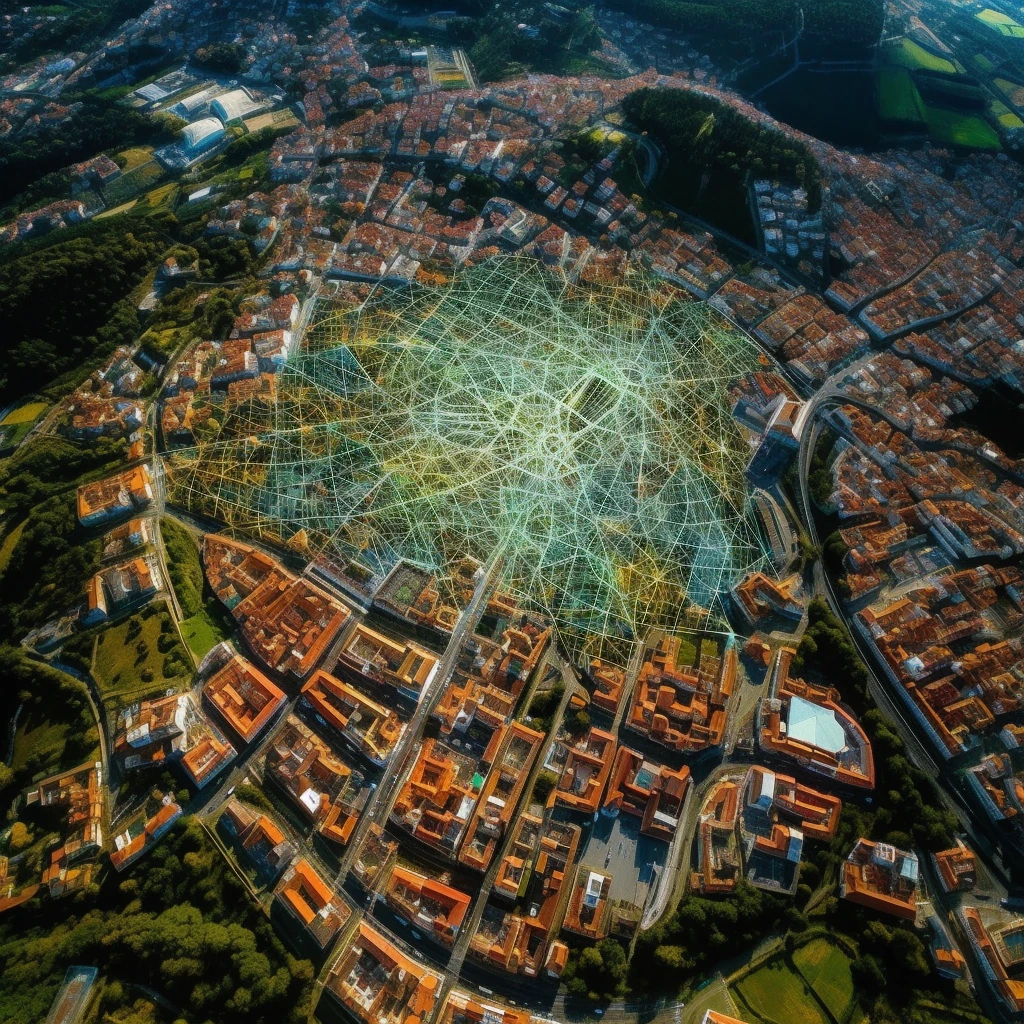
Our data sensor tiles in the Estrada da Pena district have detected increased energy usage in the area. Residents should consider optimizing the energy flow within the energy sharing network to ensure a more equal distribution among neighbors. Please increase the energy allocation by 15% for Rua da Ferraria and Rua do Moinho during peak hours (6 pm-10 pm) and decrease it by 10% for Rua das Açucenas and Rua das Camélias during the same period.
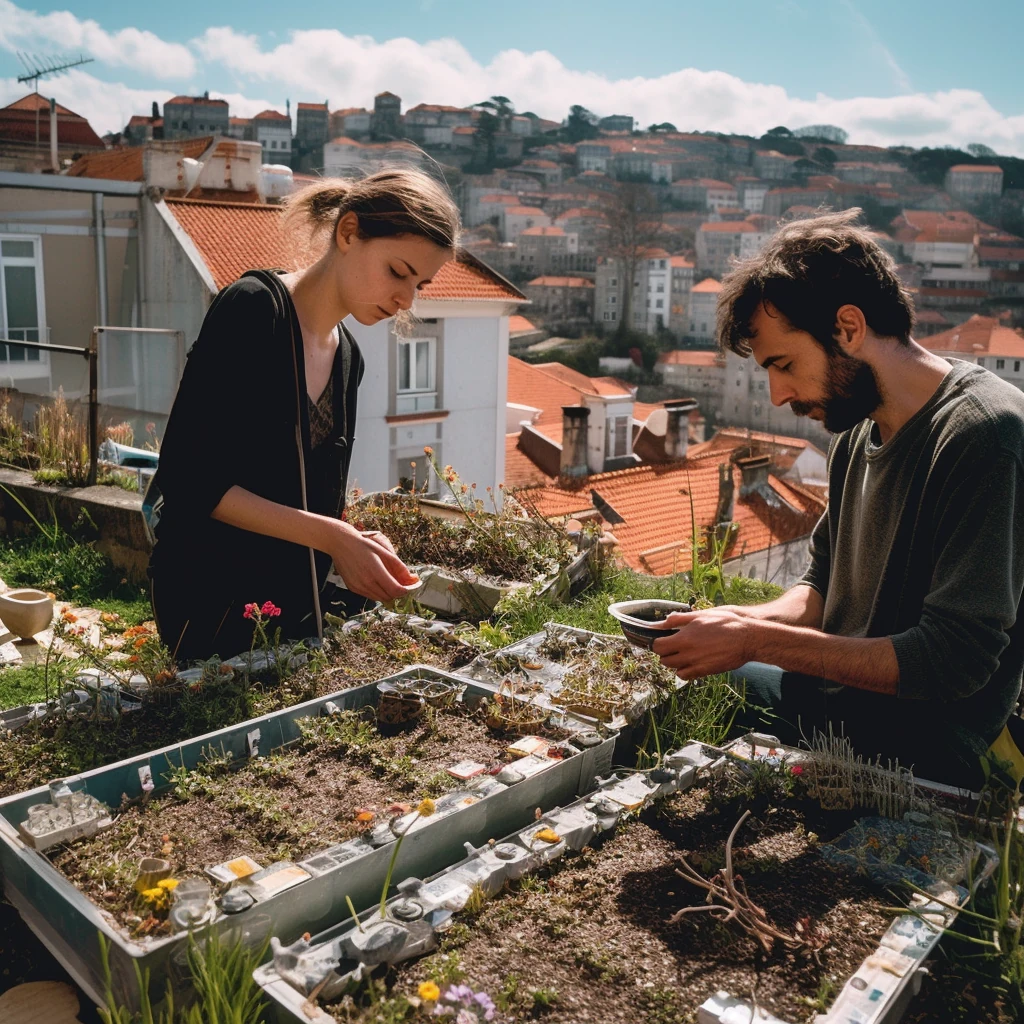
Our local flora sensors in the Serra de Sintra area indicate a decline in native plant species like Narcissus calcicola (limestone daffodil) and Lavandula stoechas (Spanish lavender). This decline may be due to human activities or changing environmental conditions. Please consider planting and nurturing these species on your property to support the local ecosystem. Residents should pay attention to their data sensor tiles displaying declining native species locations.

The tile sensors around Rio da Bica show an increased potential for groundwater recharge. Residents in this area are encouraged to install rain barrels to capture rainwater for irrigation purposes, helping to maximize groundwater recharge and alleviate potential flooding.
5. Accountability and data-driven urban climate governance. Hughes S, Giest S and Tozer L (2020)
6. Grassroots innovations for sustainable development: Towards a new research and policy agenda. Seyfang G and Smith A (2007)
7. Engagement in science through citizen science: Moving beyond data collection. Phillips TB, Ballard HL, Lewenstein BV and Bonney R (2019)
8. More Is Less: Signal Processing and the Data Deluge. Baraniuk RG (2011)
Climate Data Accessibility
Climate change demands intervention at local scales, yet citizens face barriers to participation due to climate data fragmentation and analytical complexity5. Despite the accessibility of environmental data collection hardware and grassroots interest in data-driven climate action6,7, the tools and expertise needed to process this volume of data remain concentrated in institutional research and corporate entities8.
AI as Environmental Mediator
Advances in large language models and generative AI offer new potential to process complex environmental data and help visualize implementation outcomes of targeted climate action for local communities. This technology can serve as a bridge between scientific data and community action, translating ecological patterns into practical design recommendations.
9. Rural-Urban Governance Arrangements and Planning Instruments: Municipal Master Plan of Sintra. Partidário M do R (2018)
Sintra as Living Laboratory
In Sintra, forest and buildings blend as castles and towns intersperse the vegetative landscape, with varying ecological communities in close proximity. Facing environmental challenges such as water management, coastal erosion, and desertification9, Sintra is ideal for a data-driven responsive design approach.
The Symlink system was trained on Sintra's unique population, climate, and ecological issues, prioritizing the detection of environmental risks in the dataset. For example, due to desertification risk, the system proactively recommended action to address declining soil moisture percentages.


Quantifying changes within complex ecosystems can be challenging. Utilizing data as a mediator between human and non-human communities enables adaptations to occur automatically, such as architectural facade modifications, irrigation pathway changes, or energy-sharing dispersal. For manual behavioral changes, the AI suggestions convert multivariate data into clear directions for individuals or communities.
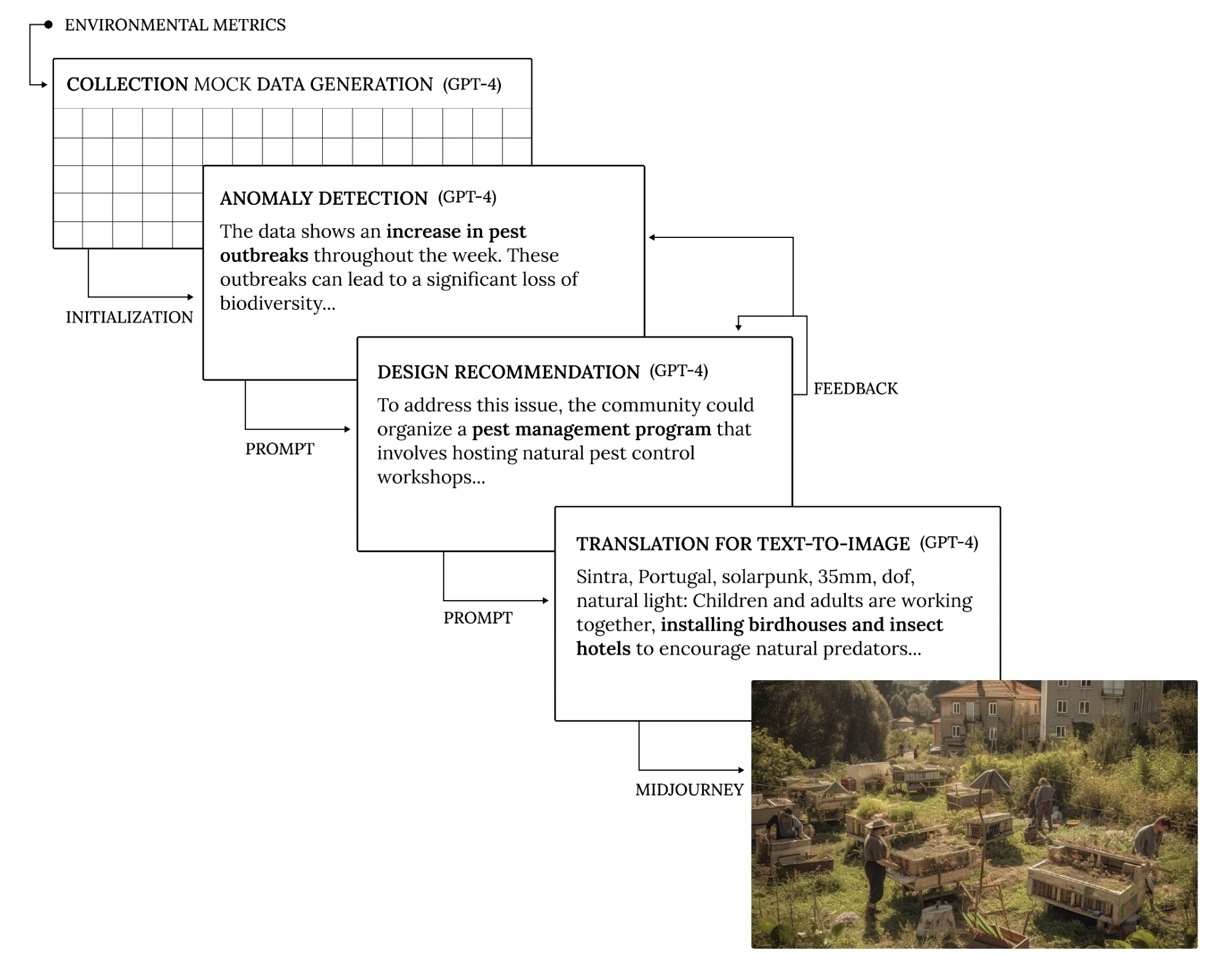
Process diagram of the SYMLINK system showcasing pest outbreak detection in a simulated two-week environmental dataset from Sintra, Portugal, and recommending community garden interventions.
Biomimetic Sensing & Visualization
Emphasizing non-human data points like plant-pollinator interactions and carbon sequestration, this project enables local ecology to influence community decisions through data accessibility. The system's physical design mimics its surroundings—sensors resembling Sea Fig plants collect population data, while Azulejo tile sensors gather microclimate data and visualize changes like declining air quality through altered tile color or pattern.
This vision enables individuals to improve their communities by concentrating on mediating the effects of climate change in their environments, which also enhances human habitation. Rather than offering a one-size-fits-all solution, Symlink adapts to different communities and their specific needs, serving as a foundation for designing unique, context-specific datascapes that reflect the distinct vernacular and needs of a given environment.